
个人中心
个人中心

今天(9.9)的托福考试,最显著的特点依然是,保持了同一场考试,多套试卷(ABCD)的方式。这是继2017年3月4日开始实施的策略,并在之后的托福考试中常态化。
同一场考试,多套试卷的目的是什么?很简单,反作弊。一是反考场内的抄袭,二是反利用时差进行考场内外的作弊。
这其实是好事。美国高校在这几年,其实已经非常反感中国大陆很多 “29+29+18+18” 之类的分数组合,并且采取了措施,一是到了美国之后要重新参加学校组织的考试,更有甚者,完全适应不了教学和课堂,最终被开除回国。
那ETS这种同一场考试,多套试卷的做法,对普通考生有影响吗?其实完全没有。既不会增加考试的难度,更不会增加考试的长度。
而且,甚至还有好处。为什么?因为ETS根本出不来那么多新题,所以多套试卷之后,它只能大量使用老题。比如昨天和今天的托福考试,就大量重复了过去的老题。
我们汇总了8-9月重复情况
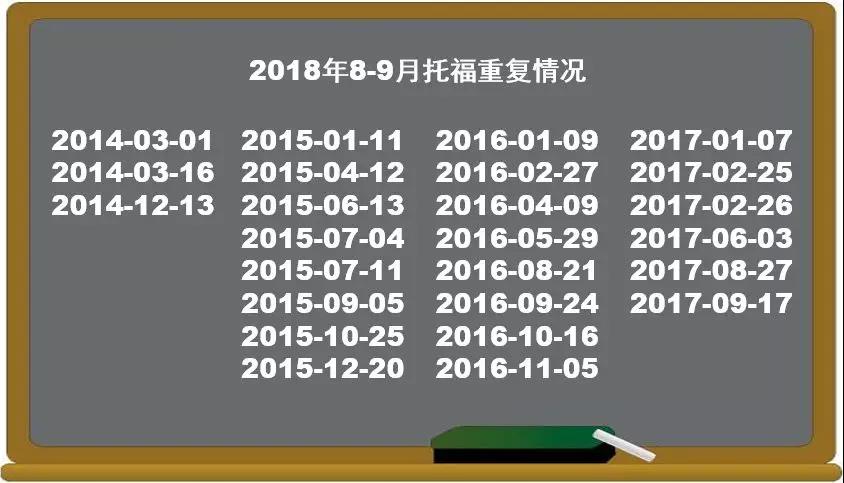
1. 从上图可以看出,今年8-9月重复的是2014-2017年托福真题,所以,我们不断郑重提醒:选择正确的机构和合适的资料进行托福备考,是时间管理的很重要的部分。
今天(9.9)A卷的三篇,仍然重复了老题,如下:
Mites and Their Hosts重复2017.09.16加试新题
Industry during the Rome Empire重复2018.05.06加试新题
Extinction of the Mammoths重复2017.01.07首考测试新题
2. 加试新题会经历多次考试检验,如果难度系数合适,就会转变为算分的测试题。这一现象在今天再次得到应证。今天的第1篇和第2篇就是2017.09.16和2018.05.06的加试题。
3. 托福常考话题内容会反复考查,例如第2篇的罗马帝国和第3篇的猛犸象灭绝。
【罗马话题的考频统计】
Economic prosperity in the Roman Augustan Age(罗马奥古斯都时代的繁荣)
Adopting Roman Values(采纳罗马价值, 罗马对整个欧洲的影响)
Transportation and the Roman Empire(交通运输对罗马帝国扩张的影响)
Industry during the Rome Empire(罗马帝国的工业状况)
the western roman empire in the fifth century(西罗马帝国灭亡的原因)
【对应考试日期】
2015年:06.27, 07.12, 12.20(3次)
2016年:01.24, 07.02, 09.03, 11.05(4次)
2017年:04.23, 06.03, 07.08, 10.28(4次)
2018年:02.04, 04.15, 05.06, 06.10, 06.23, 07.14, 09.09(目前为止7次)
【猛犸象话题的考频统计】
The Megafauna Extinction(大型陆地哺乳动物的灭绝/猛犸象等的灭绝)
The North American Megafauna Extinction(北美大型陆地哺乳动物的灭绝)
Extinction of the Mammoths(猛犸象的灭绝)
The Long History of Overexploitation(过度猎杀的长久历史)
Overkill of the North American Megafauna(北美大型陆地哺乳动物的大屠杀)
Pleistocene Extinctions(始新世大灭绝)
Extinction Trends(灭绝趋势)
【对应考试日期】
2014年:05.25, 11.08, 11.15(3次)
2015年:09.12, 11.28(2次)
2016年:02.27, 03.19, 09.10上午(3次)
2017年:01.07, 03.04 B卷, 03.11, 05.27, 06.03, 06.10, 10.28, 11.12(8次)
2018年:01.06下午场, 01.13, 03.11, 06.30, 07.01, 07.08, 09.09(目前为止7次)
. . .
Industry during the Rome Empire
(罗马帝国时期的工业)
句子简化题分享如下
考句:
What could happen when a revolutionary technique was applied was shown by the explosive growth of the glass industry after the invention of glassblowing, but this stands almost in isolation in all the centuries of Roman industrialization.
选项
The enormous growth of the glass industry after the introduction of new glassblowing techniques demonstrates the success of Roman industrialization.
Many centuries of industrialization passed before the Romans applied revolutionary techniques to the glass industry.
The invention of glassblowing demonstrated what could happen when a technique from one industry was applied to another.
Glassmaking is about the only example of a Roman industry that was transformed by the introduction of a new technique.
解析:正确答案为D。此句出现在最后一段,最后一段的主题是解释为什么罗马帝国的工业没有达到工业革命的程度的最后一个原因,是没有新技术出现。所以A选项与整段主题不符,因为罗马工业就没有达到工业革命的成功“the success of Roman industrialization”。整句话是反过来说,如果一个变革性技术被应用到工业上会发生什么,那么罗马玻璃工业的爆炸式增长就说明了这个问题,但是玻璃工业应用新技术(glassblowing)只是整个罗马工业中的一个例外(stands almost in isolation),所以正确答案是D。
- 9.9独立写作解析与范文 -
【题目】
Some people think that all university students should study whatever they like. Others believe that they should only be allowed to study subjects that will be useful in the future job, such as those related to science and technology. Discuss both these views and give your own opinion.
Which ONE of these two actions do you think would be MORE helpful for improving your performance? Why?
【解题步骤】
精准理解题目
一些人认为所有的大学学生应该学习他们喜欢的科目,无论他们喜欢的科目是什么;另一些人认为大学学生应该只被允许学习对未来工作有用的学科,比如与科学和技术有关的学科。
讨论这两个观点并给出你的意见,你认为两种方式的哪一种对提升你的表现更有帮助?为什么?
找出关键词,进行头脑风暴
a)University students
思考:大学生未来将会面对什么,需要什么?
参考答案:大学生将来会走入社会,独立进行生活,需要工作,个人生活,和他人相处,处理生活中遇到的种种问题等。
b)Whatever they like
思考:学习感兴趣的学科有什么好处和坏处?
参考答案:好处在于可以更加有兴趣去学习,取得更高成就;也可以为未来培养兴趣爱好,结实有共同兴趣的朋友。坏处在于学生未必了解社会的需求,也许所学的内容在社会上应用有限或竞争激烈,难以找到好工作;也可能某些学科的学习需要先学习其他内容打基础,但学生并不了解,若盲目学习则达不到好的效果
c)Useful in the future jobs
思考:学习对未来工作有帮助的学科有什么好处或坏处?
参考答案:好处在于可以为未来的工作提前做准备,使以后的工作表现更加出色;学习更加有目的性也可以提高学习的效率。坏处在于它限制了学生工作的选择,想要换工作将会很难;而且将学生学习的科目限制在某个领域也不利于学生的全面发展,对生活不利。
形成分论点
选择喜欢的科目:
1.学生学习喜欢的科目会更加高效
2.学生学习喜欢的科目可以培养兴趣爱好
学习对未来工作有用的科目:
1.学习对工作有用的科目可以为以后的工作做准备
2.学习具有针对性可以使学习更加高效
【范文】
The arrangement of curricular diets of students could be of major concern for both the government and the related preceptors since especially the university students, who are still detached from the multicolored society, are as suggestible as a piece of blank paper, hence even the slightest modification on their educational diets might tip the balances of their future professional and living performance. While some people argue that all university students should study whatever they like, others believe that they should be allowed to study subjects that will be useful in the future job. As far as I am concerned, I am disposed to the former argument since both the lives and work of the students in the future could be smartened up by the interest.
First, students with interest are readily to achieve higher effectiveness on the class. Hardly could anything outweigh the interest in terms of the class performance since it is the singular factor which evokes the students’ initiative. While fascinated by the class content and its future extensions and applications, students tend to delve in by themselves and even the lectures delivered by the professor pale in comparison to their radiant curiosity towards the knowledge. As a result, not only will students stay concentrated on the class which is only the basic requirement worthless to mention, they will also pursue the deeper expertise and understanding without external supervision. Undoubtedly, their related skills on the subject of passion could be accumulated at an inconceivable clip to a point going beyond the university syllabus, which in turn will become the matchless academic capital in their future jobs without intention. Conversely, even the students steered to a certain bundle of subjects which might be termed as the most practical for the present job market, appear to take the first advantage, their personal interests are neglected so that their performances including whether they could retain an ardent attitude and a high efficiency are much far from guaranteed. Thus, seldom could they be professional enough for the work if their interest and passion are worn away.
In addition, studying subjects which the students are interested in facilitate themselves to form hobbies in their future lives. People’s life quality or even the working efficiency are subject to various factors and it will be imprudent to attribute the employees’ excellence in working solely to their professional competence. As a matter of fact, an optimistic emotion should also be held in high regard since it is plain that hardly could people in depression fully exert their talents and skills on work with their minds occupied by daily fusses. And that is exactly why people with hobbies usually perform better in the work since they are capable of working off their smoldering pressure or anxiety through doing on their hobbies. In this case, were students allowed to study whatever they like in the university, they could have a much higher possibility to touch on a wide span of knowledge and activities and distinguish out their own interest spot, whereas students confined in a batch of curriculums might not for they have miserable opportunities to familiarize with the content other than the job-related materials.
To conclude, I agree with the statement that all university students should study whatever they like because this measure benefits both their working skills and positive attitudes towards life and work. (558words)